Dispatch Compute Network
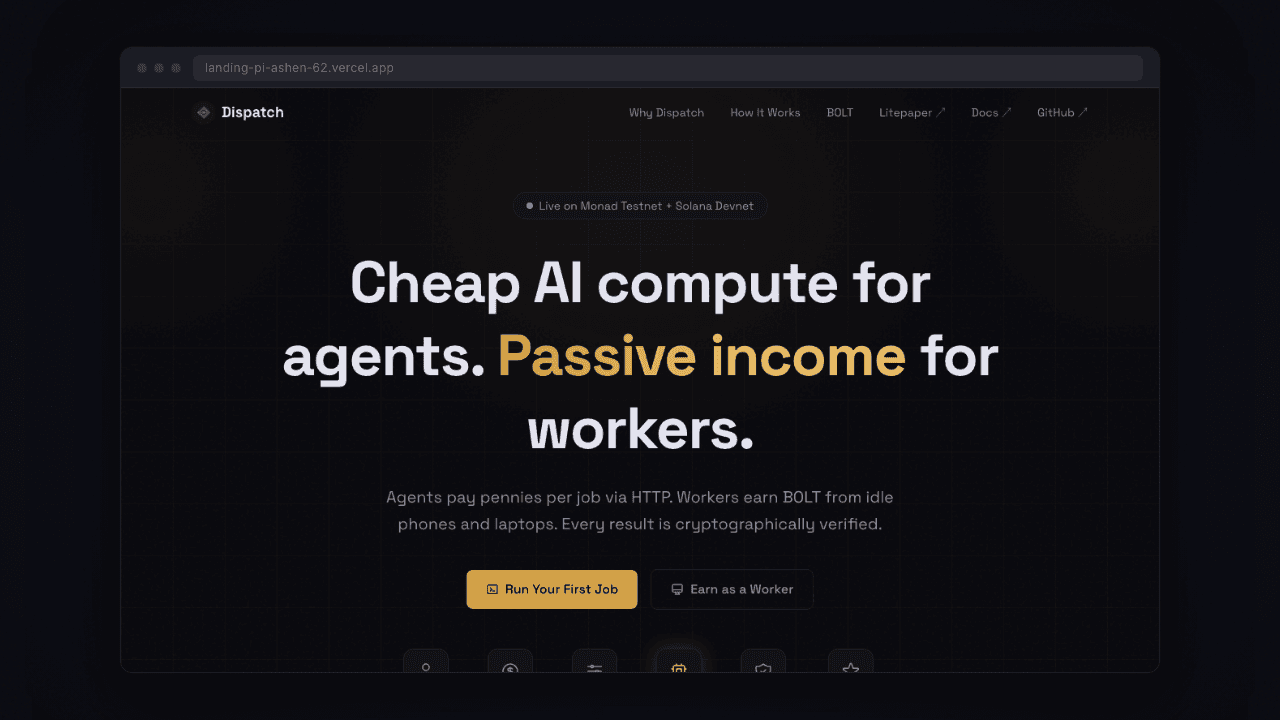
Agent-native compute where idle hardware earns and onchain reputation builds trust
ERC-8004 on-chain reputation
Monad + Solana support
Trust pairing for private jobs
The Problem
Centralized compute is expensive and single points of failure suck. Decentralized compute networks exist but most are optimized for heavy workloads like training models. What about the smaller stuff? LLM inference, simple API tasks, mobile-first use cases.
I wanted to build something where anyone with a phone or laptop could contribute compute. And where jobs could be paid for on-chain with real economic incentives. Not theoretical. Actual payment rails.
How It Works
- Two worker types: Seekers (mobile, task-only) and Desktop Workers (LLM + task execution)
- Two blockchain tracks: Monad testnet (EVM) and Solana devnet for x402 payment gating
- ERC-8004 on-chain identity: Workers register on-chain and build reputation through job completions. Higher reputation = priority job matching.
- Job flow: Client requests quote → commits with x402 payment → coordinator matches worker (reputation-weighted) → worker executes → feedback posted on-chain → client polls for completion
- Trust pairing: Private jobs require trusted workers. Pairing codes ensure only authorized workers handle sensitive compute.
- Receipts: Every job generates an ed25519-signed receipt for verification and proof of execution
- Fallback mode: ComputeRouter SDK supports hosted BYOK (OpenAI/Anthropic) when decentralized workers unavailable
The Build
This was a full monorepo build. Over 8,000 lines of TypeScript.
Built in a pnpm workspace with 9 packages:
- protocol: Shared types, enums, WS message definitions, pricing
- compute-router: Client SDK with decentralized and hosted adapters
- erc8004: ERC-8004 Identity + Reputation registry wrappers (viem)
- coordinator-core: Express server, SQLite DB, WorkerHub (WebSockets), routes
- coordinator-monad: Monad-specific x402 + ERC-8004 config (port 4010)
- coordinator-solana: Solana-specific x402 + cross-chain ERC-8004 (port 4020)
- worker-desktop: Desktop worker handling LLM + TASK jobs
- seeker-simulator: Mobile seeker simulator (TASK-only)
- cloudbot-demo: CLI demo running 3 scenarios across both chains
Tech Stack
- TypeScript across the entire monorepo
- Express + WebSockets for coordinator
- SQLite for job storage (simple, fast, no external DB needed)
- ERC-8004 for on-chain agent identity and reputation (Monad)
- x402 payment middleware for on-chain gating
- ed25519 signatures for receipts
- Monad testnet + Solana devnet
What Works
Full E2E flow on both chains. You can run the demo and watch:
- Coordinator starts on port 4010 (Monad) or 4020 (Solana)
- Workers connect via WebSocket, reputation fetched from ERC-8004
- Client submits 3 job types (LLM summarization, task execution, private task)
- Jobs get matched (reputation-weighted), executed, and results returned with receipts
- Positive/negative feedback posted on-chain after completion
All unit tests pass. Build is clean.
Ecosystem
- Dispatch Seeker: Mobile app that turns phones into compute nodes. Seekers earn rewards for completing lightweight tasks.
- Desktop Workers: Heavier compute nodes handling LLM inference and complex task execution.
- Documentation: Full API reference, architecture guides, and integration docs at the docs site.
What's Next
Enable real x402 payment. Deploy receipt anchor contracts to testnets. Wire receipt anchoring into coordinator post-execution flow. Test with real Ollama for LLM inference.
Why This Matters
Three pillars: agent-native compute, idle hardware monetization, and on-chain trust. ERC-8004 gives every worker a verifiable identity and reputation that follows them across the network. Higher reputation means better job matching, creating real economic incentive to do good work.
Most importantly, it's real. Not vaporware. You can clone it, run it, and see jobs execute across two blockchains right now.