
Where Does Crypto Go From Here?
Crypto's having an identity crisis.
And this time, there's no villain. There's no fraud. Just a mirror.
TLDR
The 2022 crash had a villain (SBF). This one doesn't. That's worse. The Web3 ideology never shipped product. AI killed the composability thesis. Speculation became the only use case. The token model is structurally broken because the CLARITY Act is stuck in Senate limbo. But underneath the wreckage: stablecoins hit $4T+ in volume (up 83% YoY), vibecoding is 10x-ing the developer pool, and the macro case for crypto is stronger than ever. The path forward is building products that pass Peter Thiel's 10x test, not writing manifestos.
The Crypto Fear & Greed Index just hit 9.
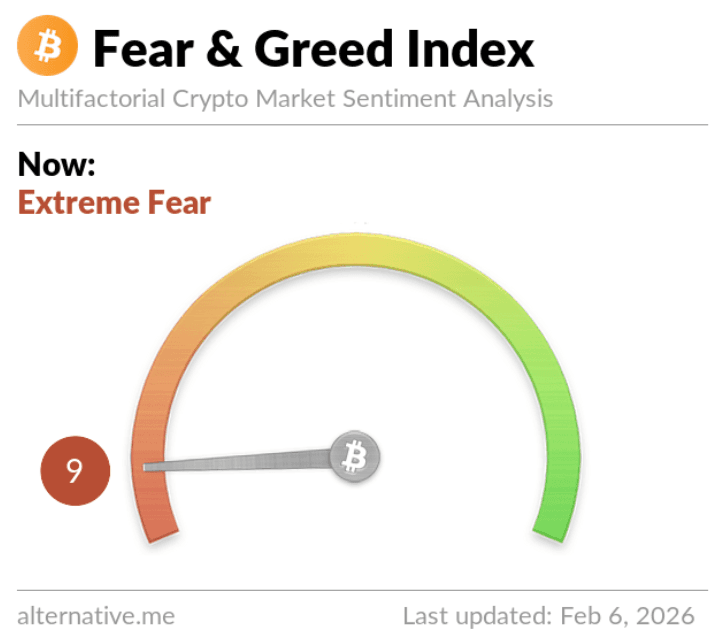
After the FTX crash, this number was 21. Let that sink in. The vibes are worse now than when the second-largest exchange on earth turned out to be a fraud.
BTC is down ~50% from its October peak of $126K. Over $2 trillion in market cap has evaporated since the top. Bitcoin ETFs, which were supposed to be crypto's great stabilizing force, hemorrhaged $545M in a single day.
But here's the thing: in 2022, crypto had a villain. SBF blew up, everyone pointed fingers, the story had a beginning, middle, and end. We processed it and moved on.
This time there's no villain. No fraud. No single catastrophic event. Just a slow, creeping realization that the dream might have been oversold.
That's a much harder thing to recover from.
The Ideology Didn't Ship
Kyle Samani co-founded Multicoin Capital in 2017, turned it into one of the most influential thesis-driven crypto VCs managing $5.9B in assets, and made the single most consequential early bet on Solana. He helped build the intellectual framework for why Web3 mattered.
Last week, he posted (then deleted): "Crypto is just fundamentally not as interesting as many crypto enthusiasts wanted. Myself included. I once believed in the Web3 vision. Dapps. I don't anymore. At its core, blockchain is just an asset ledger."
Then he resigned.
This isn't some random CT account dooming. This is one of the original architects of the Web3 thesis walking away. His timing isn't coincidental. He's articulating what a lot of people in this industry have been feeling but haven't said out loud.
The Web3 vision had everything except customers.
Composability. Decentralization. Data sovereignty. Read/write/own, as Chris Dixon elegantly articulated. Beautiful thesis. Zero product-market fit.
Permissionless building blocks, open-source composability, decentralized applications that could compete with Web2 giants... most of that hasn't materialized in any meaningful way.
The market is no longer willing to give credit for intentions.
AI Quietly Killed One of Crypto's Best Arguments
Here's something almost nobody is talking about.
Composability was crypto's strongest non-financial argument. The idea: open-source, permissionless building blocks that anyone can plug into. Why build from scratch when you can compose existing modules? This was supposed to be how decentralized software beats incumbents.
Then AI happened.
Vibecoding, agent-assisted development, whatever you want to call it: the cost to build software from scratch collapsed to near zero. Why compose existing modules when you can prompt an entire application into existence in an afternoon?
The composability thesis didn't die in a bear market. It died in the terminal. (Thanks Claude Code.)
This doesn't invalidate everything in crypto. But one of the most intellectually compelling arguments for the Web3 vision no longer holds.
Speculation Ate the Mission
So what's actually on the "cutting edge" of crypto right now?
Perps. Which are gambling.
Prediction markets. Which are, in theory, an interesting replacement for traditional media consensus. In practice, mostly a way to efficiently gamble on insider information.
Memecoins. 11.6 million tokens failed in 2025 alone: 86% of ALL crypto token failures since 2021, according to CoinGecko. Pump.fun made it trivially easy to launch a token. The market obliged by launching millions of them, most of which lasted days.
85% of tokens launched last year are now trading below their initial valuations. The median token is down over 70%.
The industry went from "we're going to rebuild the internet" to "we built a really efficient casino." The people who came in with genuine optimism are looking around wondering when the pivot happened.
Speculation has always been part of crypto. That's fine. But when speculation is ALL that's left after you strip away the ideology, you have a product problem, not a market problem.
The Token Model Is Broken (But Fixable)
Governance tokens have been going to zero. The market is sending a clear signal: a token that gives you a vote on a DAO nobody uses is worth exactly what it sounds like.
The failure of 2025's token launches isn't random. It's structural.
The GENIUS Act passed in July 2025 and gave crypto its first real regulatory win: a clear federal framework for stablecoins. That was the easy one.
The hard one is the CLARITY Act. This is the bill that would actually define whether a token is a commodity or a security and clarify SEC vs. CFTC jurisdiction. It passed the House with strong bipartisan support (294-134) but has been stuck in the Senate ever since.
Two Senate committees (Banking and Agriculture) have been working on competing drafts that still can't agree on basics like what counts as a "digital commodity" or how to handle DeFi. The Senate Banking Committee's latest 278-page draft was so problematic that Brian Armstrong publicly pulled Coinbase's support, calling it "worse than the status quo." He cited a de facto ban on tokenized equities, DeFi privacy concerns, and the elimination of stablecoin rewards as dealbreakers.
Here's why this matters for tokens specifically: until the CLARITY Act or something like it passes, the token/equity question stays unresolved. Teams can't give tokens equity-like rights without risking SEC enforcement. So they strip tokens of anything that might attract scrutiny, creating tradable assets with zero explicit claims on value.
The result: hollow governance tokens the market correctly prices at near-zero.
This is fixable, but it requires two things. Regulatory clarity so tokens CAN carry real economic rights. And teams that reimagine token design around shareholder value and genuine ownership economics instead of governance theater.
The projects that figure out how to give tokens the legitimacy of equity while preserving what makes crypto unique: programmability, global liquidity from day one, 24/7 markets... those will define the next era.
So Why Am I Still Here?
Because underneath all the noise, the fundamentals are actually stronger than they've ever been.
Stablecoins processed over $4 trillion in transaction volume in 2025, an 83% increase from 2024. Their market cap crossed $300 billion. The GENIUS Act created the first federal regulatory framework for stablecoins in the U.S. JPMorgan, PayPal, Visa, and Standard Chartered all launched or expanded stablecoin products in production. Not pilots. Production.
Stablecoins are crypto's first real, undeniable product-market fit at scale. Not speculative. Not ideological. Just better infrastructure for moving money.
The developer pool is growing faster than ever, and not for the reasons you'd expect. Vibecoding and AI-assisted development are collapsing the barrier to building on crypto. The same force that killed the composability thesis is actually a massive tailwind for crypto development: when anyone with an idea can prompt a working application into existence, the pool of people who can build on crypto infrastructure doesn't grow linearly. It grows by an order of magnitude. The next wave of crypto builders won't come from Solidity bootcamps. They'll come from people who never would have called themselves developers.
The regulatory picture, while imperfect, is clearer than it's ever been. The GENIUS Act established a stablecoin framework. The CLARITY Act, for all its Senate drama, represents genuine bipartisan momentum toward resolving token classification.
And here's the macro case that's hard to ignore: the dollar is getting actively devalued. Trust in institutions is eroding in real time. The original thesis for why crypto matters: a financial system that doesn't depend on any single government's monetary policy... is more relevant now than when most of us first got into this space.
The Path Forward
The hangover is real. The disillusionment is earned. We collectively took shortcuts, chased hype, and confused narrative with product.
But the opportunity on the other side of this is enormous, precisely because most people are too demoralized to see it.
Here's what building forward looks like:
Build products, not manifestos. The Web3 vision isn't dead, but ideology alone won't get us there. The projects that win are the ones solving real problems for real users. Not composability as an abstract good. Not decentralization as a slogan. Actual products that people choose because they're better than the alternative.
Fix the token model. Governance tokens going to zero is the market telling you something. Reimagine tokens with real value accrual, real ownership mechanics, and real alignment with the people who use the product. The teams that crack this will have a massive advantage.
Lean into what's 10x better. Peter Thiel wrote in Zero to One that proprietary technology must be at least 10 times better than its closest substitute to create a real monopolistic advantage. "Anything less than an order of magnitude better will probably be perceived as a marginal improvement and will be hard to sell."
This is the lens crypto needs to apply ruthlessly.
Stablecoins pass the Thiel test. Sending $10,000 cross-border in minutes for pennies vs. days and 5%+ fees through correspondent banking is a genuine 10x improvement. $4T+ in volume in 2025 (up 83% YoY) because it's not a narrative. It's a product that's measurably, obviously better.
DeFi passes it. Traditional finance runs on T+2 settlement: when you trade, actual assets don't move for two days. 48 hours of trapped capital. DeFi delivers T+0: instant finality. Deposit collateral and borrow against it in the same second. That's not an incremental improvement over a week-long bank application. That's a category shift.
RWA tokenization passes it. 24/7 settlement, fractional ownership, and global liquidity for assets that previously required layers of intermediaries.
DePIN passes it. Coordinating physical infrastructure with token incentives at a fraction of traditional deployment cost.
The projects that win from here won't be the ones with the best manifesto. They'll be the ones where a user tries the product and the reaction is "why would I ever go back to the old way?" That's the 10x bar. Everything else is noise.
Use the cleansing. Every previous cycle, the crash killed the tourists and left the builders. This time is no different. Less noise means more signal. Less competition for attention means the right product can actually break through.
The crypto industry has been through this before. Multiple times. Every time, the people who built through the downturn defined the next era.
The question isn't whether crypto survives. It always does.
The question is whether we finally build something worth surviving for.