How I Grew Two Crypto Communities From 0 to 100K
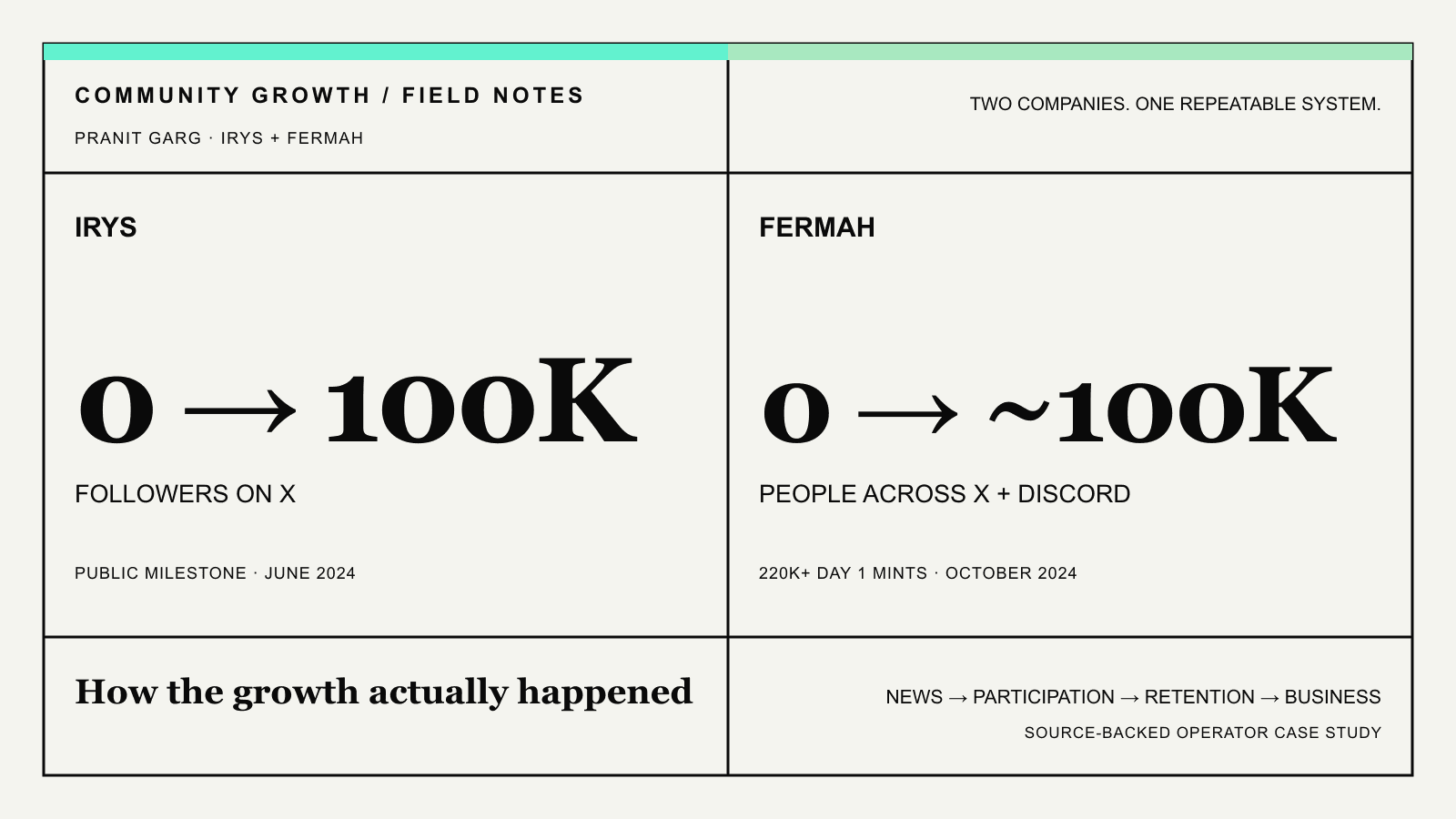
When someone asks how I grew the Irys and Fermah communities from zero to 100K, they are usually listening for a crypto community growth hack. I used the same operating system twice: concentrate attention around real news, distribute it by hand, give people a reason to participate, and do the retention work that turns reach into business outcomes.
At Fermah, I ran that sequence in a compressed three-week launch as the company's solo marketing and business development lead. At Irys, I ran it over a much longer arc with a team and a full channel system. The clock speed changed. The underlying logic did not.
First, what “100K” actually means
The two numbers measure different things, so it is worth being precise before getting into the playbook.
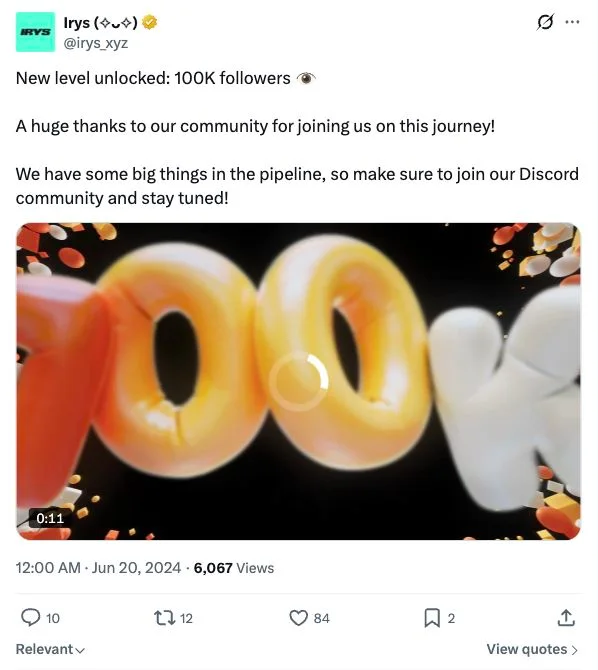
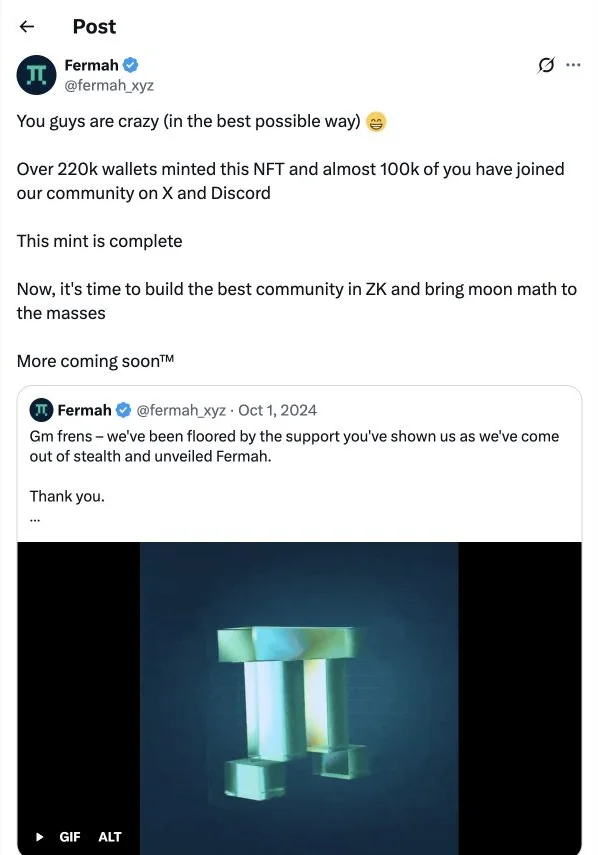
Irys crossed 100K followers on X. That is one platform and one public follower count. Fermah reached almost 100K people across X and Discord combined during its Day 1 campaign. The same public completion post reported more than 220,000 wallets minting the Day 1 NFT.
Followers and cross-channel joins are different metrics, and I keep them separate. What they share is a starting point of zero and the system that moved them.
The system behind both communities
Most companies already know the individual tactics: threads, videos, Discord calls, partnerships, events, direct messages. The advantage came from making those tactics work as one system.
1. Treat newsworthy moments as a campaign
A few moments on a company's calendar can carry market-wide attention: a fundraise, product launch, or rebrand. You cannot manufacture those moments every Tuesday, so I built a complete package around each one: narrative, video, thread, media, partner amplification, and a clear next action, all landing together.
A single announcement post leaves too much of the moment unused. The public post should be the visible tip of a much larger coordinated launch.
2. Distribute manually before expecting organic reach
A new account has no momentum for an algorithm to amplify. Early distribution came from direct coordination with investors, angels, partner projects, journalists, podcast hosts, customers, and community members. Each person received a personal message, a specific ask, and a time to act.
This work is slow and hard to show in a campaign recap. It is also what makes an announcement feel like the whole ecosystem is talking about it at once.
I treated distribution as its own operating task. I mapped who could credibly carry each part of the story, contacted them directly, made the request easy to understand, and coordinated the timing. A partner who could explain the technical problem received a different ask from an investor amplifying the company news. That coordination made each voice credible and specific.
3. Balance education, entertainment, and participation
People use X to learn, but they also open it to be entertained. A feed full of lectures loses to everything else competing for attention. I balanced three jobs: explain the product, make the brand enjoyable to follow, and give the audience something to do.
We tested platform-native formats and learned from the response. Algorithm tactics stayed secondary. The learning loop came from consistent, high-volume execution with a quality bar.
Repurposing helped us maintain that volume, but we repurposed the idea rather than copying the asset. A technical insight could start as a long-form explanation, become a sharper X thread, open a live discussion in Discord, and give the video team a visual premise. Each version kept the same core thought while doing the job of its channel.
4. Build a mesh that lasts
Reach is the top of the funnel. Retention lives in the much smaller group of people who care enough to return, contribute, and form relationships. At Irys, I thought about this as finding our “1,000 true fans.” We onboarded strong members one-on-one and deliberately introduced people who should know each other.
A broadcast audience depends on the company talking every day. A community mesh has relationships between members, so it can create value even when the team is quiet.
5. Connect content to a business outcome
A follower is an input. The useful outputs are qualified conversations, demos, users, partnerships, and deals. That distinction changed what we made and what we measured. A smaller piece of content that brought the right developer into a call could be more valuable than a viral post that brought nobody closer to the product.
I looked at the funnel in layers. Reach told us whether the narrative traveled. Participation told us whether people cared enough to act. Repeat participation and member-to-member activity gave us a view of retention. Product conversations and qualified follow-up connected the community back to the company. This kept the top-line number in context without pretending it was meaningless.
Reach
Earn attention through a real moment
Participation
Give people something concrete to do
True fans
Build relationships among the most engaged
Pipeline
Turn trust into demos, users, and deals
Fermah: three weeks from a blank slate
I joined Fermah before it had a public name or brand. I was the only person handling marketing and business development. There was no audience, no Discord community, and no established channel to borrow.
Being solo forced concentration. I structured the public launch as three one-week phases, each with a single job.
Week one: become news
We launched the company and seed round with a narrative, an announcement video, a thread, media, and partner distribution. Underneath the public campaign, I coordinated directly with investors, angels, podcast hosts, journalists, and a target list of roughly 300 projects in the ZK ecosystem. Every amplifier was a conversation I had to earn.
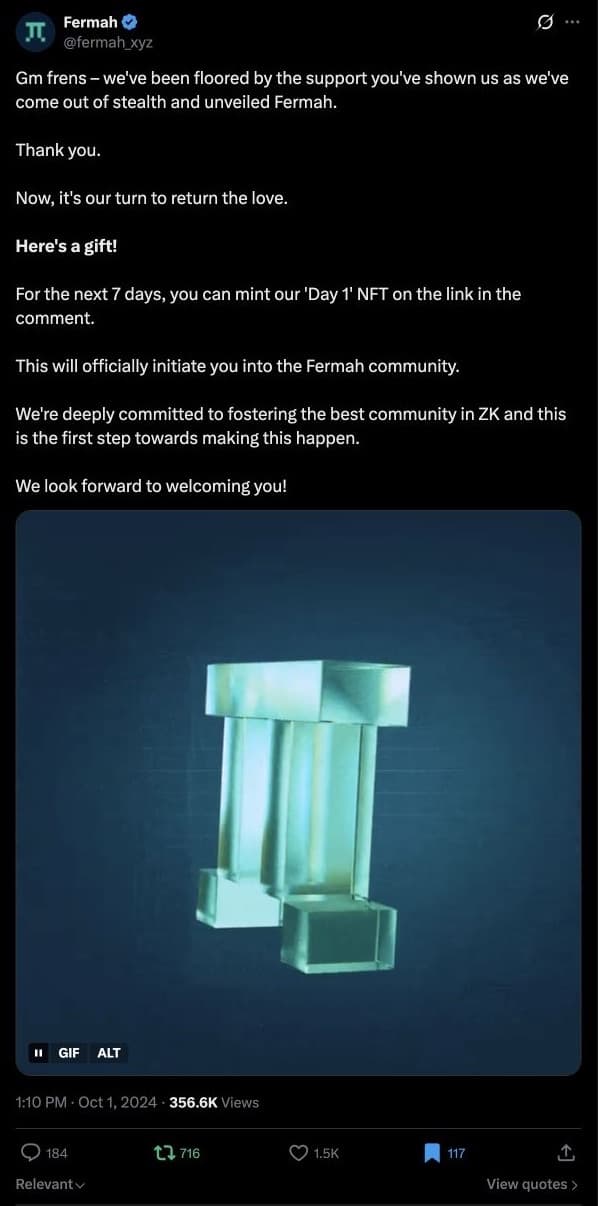
The Fermah stealth launch video. View the original post on X.
Week two: move attention toward the product
Launch attention decays quickly. The second week used the new awareness to book demos and create product conversations. We explained the problem, invited the right people into direct discussions, and connected the launch narrative to what Fermah was actually building. This middle phase kept week one from becoming a vanity spike.
Week three: give everyone an action
The Day 1 activation gave the broader audience one clear action: mint the NFT and join the community. That participation layer produced the public result: almost 100K people across X and Discord and more than 220,000 minting wallets.
Three weeks, three jobs: create the moment, connect it to the product, and turn attention into participation. Each week made the previous week's output harder to lose.
Irys: the longer category and retention build
Irys gave the same operating system more time and more surface area. X was the primary acquisition channel. Discord, Telegram, YouTube, long-form writing, partners, and events extended it. Every idea was adapted to the channel's role.
Major moments received the full campaign treatment. The rebrand is the clearest example: the video was the public centerpiece, while narrative, community, and stakeholder coordination made it land as a company-wide shift.
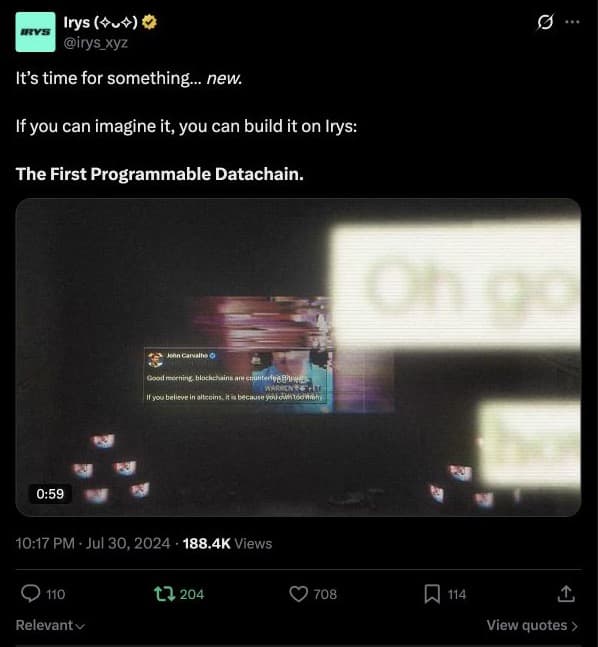
The deeper difference was retention. With more time and a team, we could work the bottom of the funnel one person at a time. We invited highly engaged members into closer groups, onboarded them directly, and introduced people based on shared interests. The goal was to make Irys a place where members knew one another as well as the brand account.
Events closed the loop. For one Lisbon gathering, we selected roughly 300 qualified people and about half attended. The team followed up with sales conversations afterward. The important point was the path: public content created reach, community work built trust, and a focused event created a reason for the right people to enter the pipeline.
What stayed constant, and what changed
The constants were real news, complete campaign packages, manual stakeholder distribution, a clear audience action, and measurement tied to business outcomes. Consistency and volume supplied the learning loop.
The constraints changed. Fermah compressed the system into a launch window, with one person doing the manual work. Irys had a longer timeline and a team, which made a true multichannel system and deeper member-to-member retention possible.
Fermah proved I could compress the system into three weeks. Irys showed how much deeper the system could go when we had time to build the category, brand, channel mix, and community relationships together.
What failed, and what I changed
The most stressful moment of the Fermah launch came about 15 minutes before it was supposed to start. A tier-one reporter we expected to publish as part of the coordinated package stopped responding. Everything else was scheduled and waiting.
I delayed the campaign.
We launched later and the result was strong, but the plan had a structural weakness: I had allowed one external person to become a single point of failure for a campaign involving many other people.
My rule since then is simple: press can amplify a launch. The launch still has to survive any one amplifier disappearing, including the most prestigious one.
The practical playbook
- Find the real news. Identify the raise, launch, rebrand, or other moment that can earn concentrated attention.
- Build a package. Develop the narrative, video, thread, media angle, partner plan, and audience action as one campaign.
- Distribute it personally. Map every investor, angel, partner, journalist, project, customer, and community member who can help. Give each one a specific ask.
- Create participation. A mint, reply, demo, event, or contribution gives attention somewhere to go.
- Use the full content mix. Teach, entertain, and involve. Learn the native language of each channel.
- Work the inner circle. Onboard the strongest members directly and help them build relationships with each other.
- Measure the business path. Track how attention becomes qualified conversations, demos, users, partnerships, or deals.
- Remove single points of failure. No launch should depend on one person replying.
If you want the closer view of the Fermah work, I wrote a separate retrospective on the brand, launches, products, and ecosystem relationships in From Stealth to 100K+: My Time at Fermah.